 Beautiful fountains and creative fountain designs from all over the world.
Bellagio Fountains
 Floating Fountains
 Vortex Fountain
 Fountain of Rings
 Crown Fountain
 Banpo Bridge Fountain
 El Alamein Fountain
 Dancing Fountain in Dubai
 Fountain of Wealth
Beautiful fountains and creative fountain designs from all over the world.Floating FountainsVortex FountainFountain of RingsCrown FountainBanpo Bridge FountainEl Alamein FountainDancing Fountain in DubaiFountain of Wealth
1. One Million Bottles of Beer in the Temple Wall 2. Spiral Island: The Floating Island Made from Plastic Bottles
 3. The Original Plastic Bottle Boat
 4. Recycled Bottle Dome Roof
 5. Beer Bottle Solar Water Heater
 6. Recycled Bottle Screen
 7. Recycled Bottle Cascade Lamps
 8. Funky Recycled Plastic Bottles Christmas Decorations
 9. Recycled Wine Bottle Serving Tray
Even when it comes to weapons, man’s creative and dare I say artistic, ingenuity comes to the fore. If it is possible to have one weapon, then why not turn that weapon into two by fixing a blade or a club on it? As for pistols – let’s have six barrels, a muff pistol, a palm pistol, or a ring pistol. This is a look at some interesting and some unusual antique guns that gunsmiths have created in the past.
Also here, is the gun described as “the most beautiful gun in the world” and the story of how it came to be in the Metropolitan Museum of Art.

In simplistic terms, the earliest forms of firing mechanism involved manually placing a burning ember or flame to a hole in the top of the barrel of a “gun”. This was replaced by a matchlock, which basically was a method of securing a very slow burning fuse (known as a match) to the side of the gun, which was introduced to the touch hole to explode the powder in the gun.
Of course wet conditions or an ember in close proximity to the powder were not the most favourable of situations and accidents with muskets were not uncommon
The breakthrough came with the invention of the Wheellock.
This involved mechanically moving a scored disk of steel against a piece of mineral called pyrite to cause sparks. The easiest way to understand this is to look at a modern flint cigarette lighter. This works in basically the same way.
The mechanism of the Wheelock was rather complicated and there were attempts to simplify it. There were several variations but one of the most popular was a Dutch invention called the Snaphaunce. (Derived from the Dutch “snap haan” meaning snapping hen, a reference to the movement of the arm containing the flint.) There were problems because of a need to have a moveable cap over the ignition hole, to stop accidental ignition and to keep the powder dry.
However it was not until the invention of the Flintlock in France by Marin Le Bourgeoys that a far more reliable mechanism came into being. This involved an arm containing a piece of flint striking a metal L shaped plate. This not only caused a spark but forced the plate to uncover the touch hole at the same moment.
This was a system that would last for around two and a half centuries until the development of percussion methods of firing took over.
Of course as well as working on the firing mechanism, gunsmiths were also looking at ways of developing the guns themselves

The oldest weapon here is a combination of a pistol and a mace. It is from Northern Europe, from Saxony, from the last quarter of the 16th century (1575-1600). It is on display in The Military Historical Museum of Artillery, Engineer and Signal Corps (founded in 1703 in St Petersburg, Russia by Peter the Great.)
This gun/club almost signals a time of transition from knight in armour to cavalryman or infantryman. It is interesting to note the straight stock-style handle and the intricate decoration. The decoration indicates that the weapon would have been made for a member of a wealthy family and not a “commoner”.

The problem with a muzzle loaded gun is that once it has been fired it is necessary to pause to reload with ball and powder. Not very helpful if you are being attacked by more than one assailant. One alternative would be to have more than one gun. Again not very comfortable for a man about town wanting to protect himself from a mugging. Much lighter would be one pistol with two barrels. Several companies began manufacturing double barrel pistols such as the one shown above made by the gunsmiths Hill of London.

If two barrels were useful, how much more useful six barrels would be. Like this one manufactured by Blunt and Syms of New York.
The pepperbox or pepper pot pistol has appeared with all the various firing mechanisms previously mentioned. The principle has always been basically the same. A solid unit consisting (in this case) of six barrels rotates around an axis. Each pull of the trigger caused the barrels to rotate through 60 degrees thus lining the next barrel up for firing. Because of the problem of weight, the barrels were usually no longer than three inches (3.5cm) long. It is easy to see from this, how the potential for reducing the size of the barrels to form chambers and putting one barrel in front of the chambers would lead to the development of the revolver.
The example shown above has a ring trigger.

An alternative to being able to shoot multiple shots from more than one barrel is to fire multiple projectiles from one barrel with one shot.
Rather than sending a single bullet to one target, the blunderbuss was designed to send multiple bullets over a given area. Its muzzle is wider than the rest of the barrel, intended to spread the shot over a given area. The early flintlock versions of the gun were very popular with guards on mail coaches and with householders for home defence.
Some of these weapons were issued to the army and the navy. It can be imagined that they would have been used by the navy in close combat, possibly to repel borders, or in boarding. It is probably for that reason, that the example above is fitted with a sprung over bayonet, as is the pair of pistols shown below.
Also note the ramrod held under the barrels for loading.

The date of this pair of pistols is from around 1820, and signed by Sherwood of London.

From the 18th century small concealable pistols for self protection, were manufactured in Europe in large numbers. The picture shows a flintlock example manufactured in 1820 from Birmingham England.
Measuring just over 4 inches (11.8cm) these lightweight guns were intended mainly for women. As they could easily be concealed in a Ladies hand warmer, they gained the name of Muff pistols.
Like many of this type of weapon it is fitted with a sliding safety catch to prevent accidental discharge.

A palm pistol is one of the latest weapons shown here.
Patented around 1883 the earliest was known as the Chicago Palm Pistol. This percussion weapon was able to be concealed in the palm of the hand and operated by holding the fingers over the lugs either side of the barrel and squeezing with the palm of the hand.
The photograph above is of a unique design called “The Protector” from 1891-1892 by the Minneapolis Firearms company.
According toFlaydermans Guide to Antique Guns,9th edition, these were actually built by James Duckworth of Springfield, MA. It features a 7-shot cylinder which is really more like a rotating turret.

This weapon made in the late 19th century is a rare six shot pin firing revolver. It is a silver ring that fits the finger and features a hand rotated pepperbox barrels locked by a bar catch. The ring is engraved with the words “La Petit Protector”

Should a “gentleman” feel that his honour had been offended, he would call on the offender to take part in a duel to remedy the offence. Formerly fought with swords, with the advent of the gun, duels would now take place with pistols. The wealthy families would be able to commission fine sets of duelling pistols which would be passed on from father to son.
The duellists would meet discretely, usually just after dawn. With them they would each have their own “seconds.” (A term which is now carried on in the boxing world.)
The duties of the seconds were several fold. Firstly they were there to try to settle the dispute verbally before the parties resorted to the duel. They were also to attend to any injuries resulting from the duel.
Another duty was that they were supposed to check that neither of the weapons contained rifling. (Grooves manufactured into the inside of the barrel to make a bullet travel more accurately.) This was supposed to be “ungentlemanly”. It has been suggested that on some occasions one of the pair may have been rifled and the other not.
It is possibly this that led to the story by Jonathan Gash called the “Judas Pair”. A pair of duelling pistols that, where one fired honestly, the other pistol had a mechanism which released the shot backwards to kill the person using it. But that’s just a story…isn’t it?
Duelling was finally banned in England in 1810.

A tschinke was a light hunting rifle used mainly for shooting birds. It takes its name from Teschen in Poland (where this type of weapon was developed) and was a popular hunting weapon among the north European nobility during the seventeenth century. The nobility were able to afford to have, beautifully, ornately inlaid decoration on their guns, like some of the examples shown below.
It can be seen that there is not a great distance between the trigger and the end of the stock. This is because the gun was not used by cradling into the shoulder. The stock was placed against the cheek. The gun itself absorbed most of the recoil.


(Detail: Louis XIII initial can be seen inlaid.)
An Obituary from the New York Times, June 7 1999, by William H. Honan.
“Randolph Bullock, a curator emeritus of arms and armor at the Metropolitan Museum of Art……
“As a curator, Bullock was frequently involved in acquisitions. One of the most extraordinary of these was the museum’s long effort to acquire the fowling piece of Louis XIII of France. That legendary long gun was then owned by William G. Renwick, a reclusive gun collector who kept his prizes hidden from sight in his home in Tucson, Ariz.
“The Louis XIII hunting weapon is not only considered the most elegant 17th-century long gun in existence, but it is also one of only three flintlocks known to have been made in the workshop of Pierre and Marin Le Bourgeoys of Lisieux, the gunsmiths who invented the flintlock ignition mechanism.
“Bullock was one of three Metropolitan curators beginning in the 1920s who tried to acquire the weapon, which they called “the most beautiful gun in the world,” before it could be snatched away by the Smithsonian Institution, another museum or a private collector.
“Several times it appeared that Renwick had been wooed and won, but he always backed off at the last minute. Then, after his death in 1972, his collection came up for auction at Sotheby’s in London. Bullock pounced, and an agent for the Metropolitan bid $300,000 and gained the prize.”
 In North Africa, there are 80 blocks of such pyramids scattered around the Egypt's Nile River, which have become one of the most miraculous places in the world. The highest pyramid called Cheops Pyramid and it was build by overlapping pile of boulders together. In the making of pyramids, Egyptians were not using any adhesive, glue or nails to attach the pile of boulders and one could even hardly find cracks or gaps among the rocks or stones from the overlapping plot. Nevertheless, the structure is extremely firm and strong that the sharp blades or swords could not even pass through. In addition, Egyptian Pyramids have experiencing 5,000 years of strong wind's erosions and yet these artifacts are remained not touch by the nature. They appeared to stand alone like warriors in the desert. These towering pyramids are such spectacular and superior buildings human had ever made on the Earth.
 This is a mysterious place encountered in the Antarctic Island. People call it “a dry valley with no snow cover.” Antarctic is a place with fewer inhabitants and dwellers and thus some unexplainable phenomenon happenings in Antarctica remain mystery to the outsiders. Approximately 14 million square kilometers of the total area of the Antarctic continent have the snow cover. When viewing from the high sky, the central of the Antarctic is like a pot's lid plateau. Most of the areas vividly have their surfaces covered with snow with its thickness reaching 2000m and sometimes may attain the thickness up to 4,800m. In winter, the surrounding ice combines with the ice from the ocean to form up one smooth, large plateau to which people can hardly distinguish between the land and the sea.
 Bermuda Triangle is located in Western North Atlantic, which comprises of seven major islands, 150 small islands, some islands composed of reefs group. Any high-tech devices or equipments will become malfunction when reaching this mysterious
 In China, people have named this desert as “Moguicheng” or a city of devil. “Moguicheng” is famous in Xinjiang, China. When someone is strolling towards the castle in a sunny day accompanying with a gentle blowing breeze, one may heard a nice rhythm coming from the distance. The melodies are just like 10 million shaking bells, and sometimes one may feel the music like gentle flicking of 10 million guitars' strings. However, when cyclones come, bulks of sands are rising up in the sky by the strong winds, the sky turns pitch dark suddenly like a hell, and the nice music no longer heard but turns into strange sounds. The sounds resemble the roaring of the tigers, trumpeting of the elephants, and sounds by pigs that are being slaughtered, babies' crying, shouting of the women who are going to die, and alternately the sounds change to shouting, mourning and quarreling. The storms are then swirling aggressively by shooting up to the sky accompanying by terrified wolf growling sounds in the cloudy nightfall. People are wandering who had built this city and where do the sounds come from?
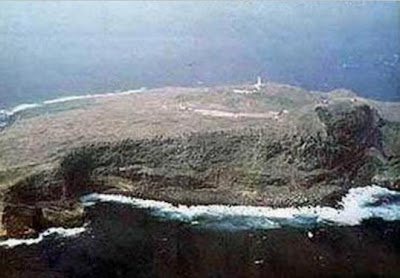 This island is legendary full of Surreptitious and specter. Westerners prefer sailing by venturing many historically strange events occurred here in the history of seafaring. In 1707, the British captain of the Andean Julius had discovered this land; however, it was strange that he could hardly reach this land. He later affirmed that this was not an optical illusion, so he marked the “land” on the map. 200 years later, the admiral Makaluofu and his inspection team who were sailing to the North Pole on their icebreaker vessel called "Ye Ermake," accidentally came across this piece of land. In 1925, Navigator called Woershi, too, passed through this land and he memorized the outline of the land. Nevertheless, the investigation team comprising of scientists, who sailed to this land in 1928 never found any islands as claimed by the previous navigators.
 This place is located in Henan, China, and local people called it “bingbing bei” or the back of the ice. When midsummer approaches, people tend to move to places that are cool and refreshing. Although the change of four seasons, namely summer, autumn, spring and winter is an unchangeable law, in certain parts of the world, this theory seems not to be applicable. They are some fortunate people live in “warm” zone. This phenomenon is applying to people dwelling in the eastern mountain areas of Liaoning Province, China. They are experiencing warm temperature while other areas of China are experiencing the changes of seasons. Thus, this area has named after this phenomenon as "temperature anomaly zone." This "geothermal anomaly zone" extends from 1.5m out of the town of the left riverbank of Hunjiang to the end part of the right riverbank of Hun River and to the foothills near Guandian Province. The entire length for this "temperature anomaly zone" is approximately 15km, occupying the areas of approximately 106,000 square meters. The advent of summer is always accompanying with a decline of temperature in the area of "temperature anomaly zone." When the temperature reaches as high as 30 degree Celsius during the summer, the temperature is minus 12 degree Celsius at one-meter deep into the underground of this area, and the ice froze underground. When someone dips a drop of water one-meter deep into the underground of this area, the water will immediately turn into ice.
 Shennongjia is located at the intersection of Sichuan, in Hubei zone, with the meeting of two rivers, namely China's Yangtze River and Hanjiang River. This region comprises an area of 3,250 square kilometers, accounting for more than 85 % of woodland. The average elevation is 1,700m, with the highest point of 3,105 meters, and with the characteristic of various types of climate. When speaking of Shennongjia, people here will think of “savage.” Since ancient times, large numbers of documentations have revealed the existence of savage roaming around this area. Legendary, people could even hardly identify the authenticity of the savage. The effort of collecting evidence on the existence of savage was initiating by the relevant departments from 1977 to 1980. They had collected savage hairs, footprints and feces left by the savage. This proved to us that a kind of bizarre animal might have existed in Shennongjia not long ago.
 This is the famous ancient city of Teotihuacan in America, which called “death to the road.” This region stretched from a so-called main road of “death to the road” to the north-south roadway. In the tenth century AD, Ards heroes who were the earliest team walking along this way leading to a castle found nobody in the city, and thus they believed that the buildings on either side of the road were gods' tomb lands. In 1974, a Mexican person called Dayton • Halisi said that he had found a suitable unit measurement for all these streets and buildings at this city at the International American meeting. This unit length is 1.059m using a calculation from a computer. For example, the units for the Teaodiwakan snake temple, the moon and the Sun Pyramid is the height of 21, 42, and 63 "units" respectively with the ratio of 1:2:3 based upon the ancient calculation.
 People not allowed entering this Kunlun Mountains as its name suggested as "The Gates of Hell." This valley is a death valley, which further claims the Kunlun Mountains "The Gates of Hell." The remains found in this valley were the furs, bones, skeletons of wolves, bears and hunters and some scattered lonely tombs, rendering the world in the death of a ghastly terrifying atmosphere. The Xinjiang Bureau of Geology and Mineral Resources of a geological team in China had recorded a true story in the year of 1983 on a group of hungry horse that was grazing the grass and disappeared suddenly in the "The Gates of Hell." A herdsman went into the prohibited area of "The Gates of Hell" to search for his horse. After few days, he was found missing but the horse emerged at the foothill of Kunlun Mountains. Later, the herdsman was found lying on a small hill with his clothes badly torn off, barely footed, eyes widely opened with an angry look, a shotgun gripping in one of his hands showing that he was reluctantly to die. The miraculous thing was that no wounds or signs found around his body to show that he had attacked.
 Canada Niagara Falls is the world's most mysterious places in the world. Niagara Falls constitutes a part of Canada and the border of United States, the New York State and Ontario, Canada, separating from the Niagara River by flowing northward from Lake Erie to Lake Ontario with a total length of nearly 30 miles. Located in the north, covering an area of 250,000 square miles, Niagara Falls is a smooth exit to these lakes. Its maximum water flow reaches 250,000 cubic feet per second. Niagara Falls is indeed very awesome.
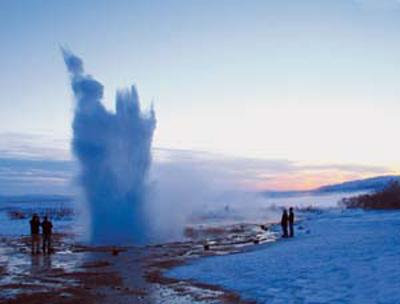 This Geysering is a magical spring found in the upper part of the Yarlung Zangbo River in Tibet, China. The spring bursts out in a short while and stops for a while before following by other bursts. The burst goes on, stops and goes on. In other words, its eruption cycle is continuous for a few minutes, auto stop after a few dozen minutes; and followed by another burst and so forth. It bursts like an eruption with a huge, shocked sound. It vents out some high temperature steam from the mouth of the spring. The spring then expands immediately into one to two meters in diameter, and rushes out as water column as high as 20m into the sky. In addition to China's Geysering, in the place near Reykjavik, capital of Iceland, the Geysering is renowned in the world with its diameter of 20m. When there is drizzling rain, this water column can even soar up as high as 70m into the sky.
 OK, we’ll start with an easy one. It’s a hand that’s hard to miss both because of its size and because, well, it’s kind of familiar. Like our own hands, this ape’s mitts are capped off with fingernails, and what’s more they’re endowed with those inimitable opposable thumbs. Opposable thumbs allowed this African beast to evolve more accurate fine motor skills – you know, the fiddly stuff like picking your nose – and are also thought to have led directly to the development of tools.
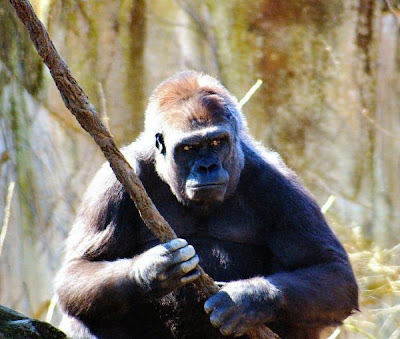 It’s the greatest of great apes, the Gorilla, and this surly looking hombre looks to be tooled up with a big branch. Gorillas are one of our closest relatives – second only to chimpanzees – having split from our evolutionary path as little as 7 million years ago. They’re highly intelligent, and not only use their fingers for manipulating food, but like all the great apes have a semi-precision grip. This means they can use basic tools and improvised club weapons, and have even been recorded employing more sophisticated tool use, like using a stick as if to test the depth of water while crossing a swamp.
 That’s a pair of hands that wishes it were clinging onto something other than the inside of cage – really in this case as the critter they’re connected to has been known to seriously harm itself if locked up. We’re not going to tell you who they belong to yet – that would be giving the game away – but we’ll give you a clue. It’s another primate, like us and the largest of the group the Gorilla, and what makes its hands the real deal is that they too are blessed with a kind of opposable thumb.
 Not so obvious this time, eh? This buggy-eyed little beggar is the Tarsier, an insect-eating beastie found only on a few Southeast Asian Islands like the Philippines, Borneo and Sumatra, and which fossils indicate has not changed a lot in 45 million
 Like most members of the primate order, this cheeky chap’s hands have five digits as well as sensitive pads on the undersides of fingertips, but it’s lacking in the old opposable thumb department and has claws instead of nails on every digit barring the big toe. This means this little monkey – oops! – is not quite so dextrous when it comes to gripping objects with precision, though it’s still pretty handy at climbing trees, picking fruit and scratching for insects.
 Any ideas? It’s the Pygmy Marmoset. The Tarsier may have been small, but this little critter takes the cake in the tininess stakes, standing as it does as among the most diminutive primates and the smallest of all monkeys. Sometimes called Dwarf Monkeys, Pygmy Marmosets have a body length of just 15 centimetres. So, while you’ll have a hard time trying to catch a glimpse of them, if you trek hard enough you may at least hear them in their native habitat of the South or Central American rainforest, where their calls reverberate down from the canopy tops.
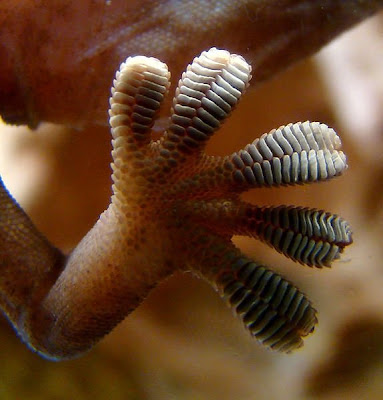
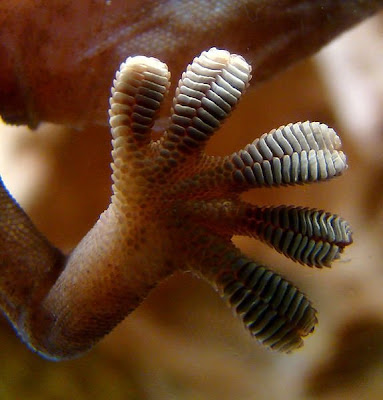 These suckers this mitt belongs to are an everyday sight in homes in warmer climates around the world, where they often become part of the furniture – welcome guests who gobble up all sorts of insects such as mosquitoes. However, they’re equally renowned for their astonishing wall-climbing talents, the result of specialised toes that allow them to scale smooth, vertical surfaces, and even effortlessly cross ceilings. Note to pedantic types: technically this guy has feet, not hands, but they’re handy enough for us.
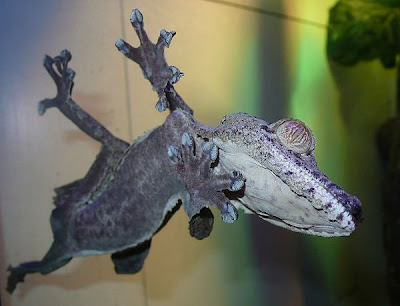 Guessed yet? It’s the groovy Gecko. The toes of these lizards have developed a uniquely adapted ability that allows them to adhere to almost any surface, without the use of fluids for example. In a cool(-blooded) illustration of nature’s physical chemistry, every square millimetre of the Gecko’s footpad is covered with around 14,000 hair-like setae, and each seta is itself delicately divided to interact with the surface at a submicroscopic level and produce the attractive forces that keep a Gecko stuck there. Phew. Who’d have guessed the wall-crawling exploits of the many-coloured Gecko would be so insanely scientific?
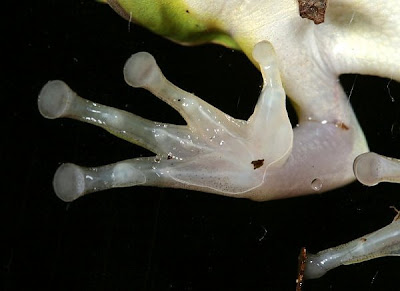 5. A dab hand…
The last addition to our list is another non-mammalian animal with some superior skills at its fingertips. Those well-developed discs at the ends of its finger and toe tips are all about adhesiveness, though of a wet kind unlike the Gecko’s; yes, this is a creature that likes to climb too. The fingers and toes themselves as well as their associated limbs tend to be a little on the lanky side, and the end result is some top of the tree grasping capabilities. …it’s the Tree Frog
Will the owner of these hands please hop forward? Ladies and gentlemen, the Tree Frog. As you’d expect, the typically tiny and brightly coloured Tree Frog is found in very tall trees and high-growing vegetation. There are many different species, but two genii stand out as worthy of special mention. Chiromantis can oppose two fingers to the other two, resulting in a vice-like grip that even predators may need to heed, while Phyllomedusa, pictured above, has a form of opposable thumb. It’s all bound to help if you’re in a climbing club like these suckers. Safe hands and all.


Extraordinary Thing Copyright © 2010 Blogger Theme is Designed by Lasantha